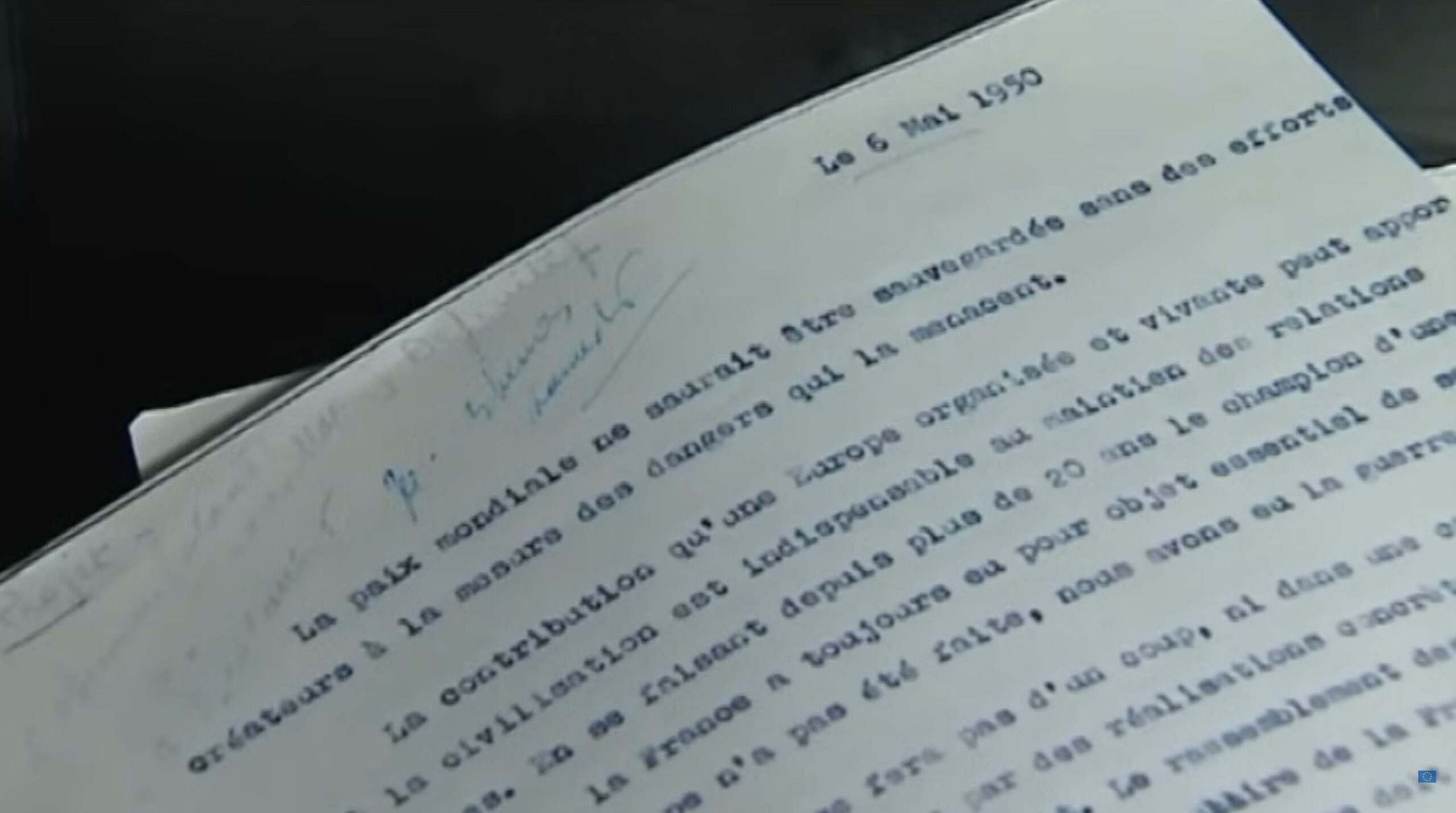
THE SCHUMAN DECLARATION
“World peace cannot be safeguarded without the making of creative efforts proportionate to the dangers which threaten it”.
Robert Schuman, May 9th 1950
The founders of today’s European Union came from many different backgrounds—including resistance members, jurists, public servants, and elected representatives—but they shared a common ambition: to replace conflict with cooperation and to build a Europe founded on peace, democracy, and shared prosperity.
PEACE, SOLIDARITY AND PROSPERITY
“It is in times of hardship that we must find the courage and the resources to make a new start. Now it is our generation that is being asked to summon up the same courage as the Founding Fathers, to focus on the common future of that project, which so many the world over view as an example of peace, solidarity and prosperity”.
David Sassoli, May 9th 2020
From the speech of David Sassoli, President of the European Parliament, on occasion of Europe Day 2020
EUROPEAN CIVIL PEACE CORPS
“Sole reliance on the traditional resources associated with political, diplomatic or military strategies is inadequate for conflict prevention and there is a need for a comprehensive peace-building approach”.
EP resolution, December 13th 2001
The European Parliament (…) having regard to its recommendation of 10 February 1999 on the establishment of a European Civil Peace Corps (…) whereas the scale of any possible conflict in the modern world underlines the necessity to maintain both a parallel global and European approach simultaneously (…) whereas sole reliance on the traditional resources associated with political, diplomatic or military strategies is inadequate for conflict prevention and there is a need for a comprehensive peace-building approach (…) whereas the UN Charter is the ultimate international legal and political basis for guaranteeing international security and for the security policy of the European Union and its Member States, and has universal validity (…) Reiterates the necessity of establishing, in the framework of the Commission’s rapid reaction mechanism, such a European Civil Peace Corps, whose task would be to coordinate at a European level the training and deployment of civilian specialists to carry out practical peace-making measures such as arbitration, mediation, distribution of non-partisan information, de-traumatization, and confidence-building between the warring parties, humanitarian aid, reintegration, rehabilitation, reconstruction, education, and monitoring and improving the human rights situation, including human rights accompaniment measures (…)
European Parliament resolution on the Commission communication on Conflict Prevention (COM(2001) 211 – C5-0458/2001 – 2001/2182(COS) )
The information and views set out in this publication are those of the authors and do not reflect the official opinion of the institutions where they work. Neither the European Union institutions and bodies, nor any person acting on their behalf, may be held responsible for the use which may be made of the information contained therein.
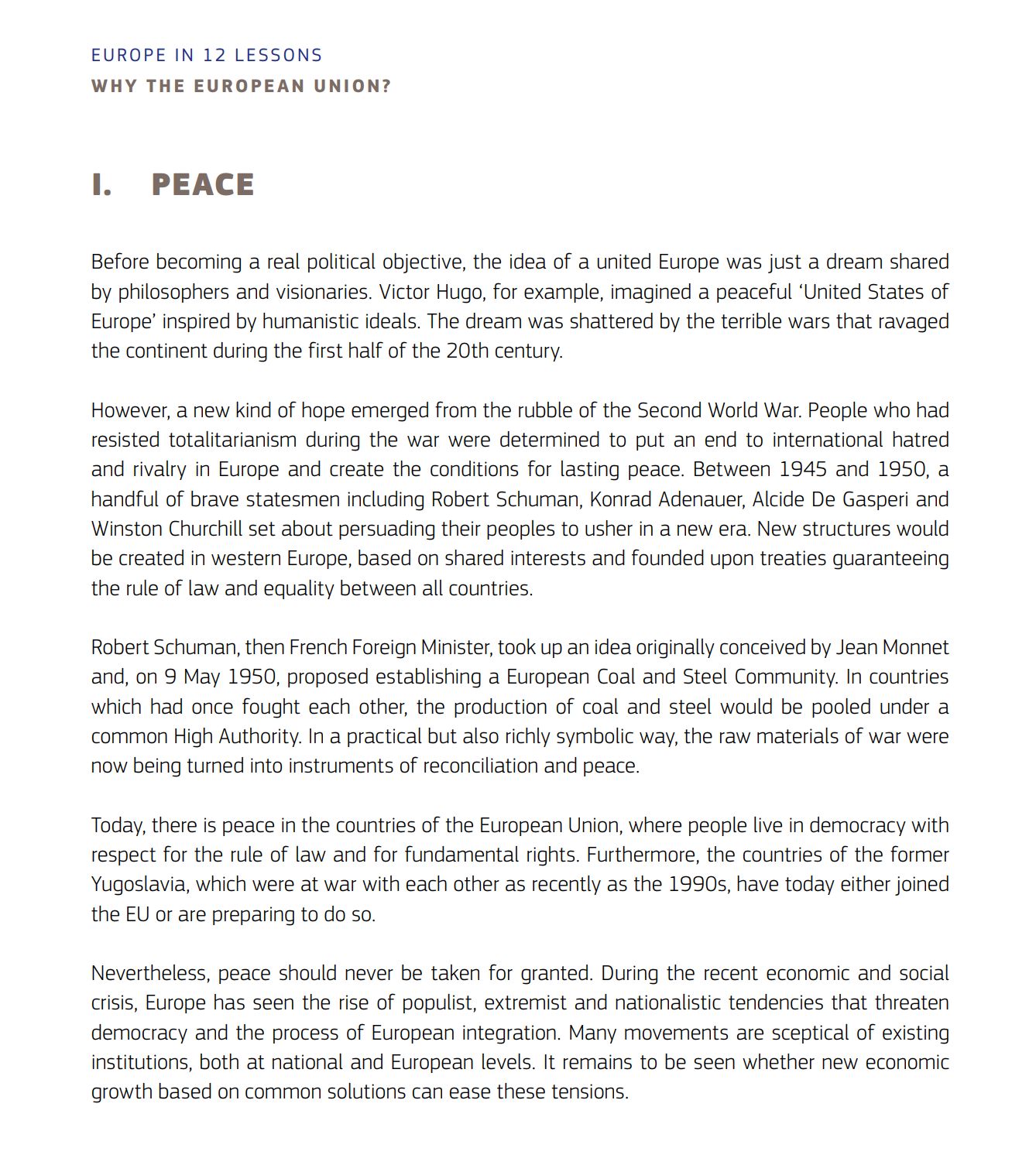
EUROPE IN 12 LESSONS
“Peace should never be taken for granted”
EU Publication “Europe in 12 Lessons“
In the official EU publication “Europe in 12 lessons”, Peace is lesson number 1, describing the creation of a shared economic space as a “practical but also symbolic way” to create the conditions for a lasting peace between countries that were once at war.